Question 2
Either
With reference to TRIUMPHAL MARCH FROM “AIDA” by G.Verdi.
- State the period of Western music history in which the composer lived.
- What term indicates the tempo of the music?
- Identify the two keys used in the piece.
- What is the major difference in texture between the treble and the bass staves?
- Quote the opening three bars of the melody.
- Identify any one contemporary of the composer.
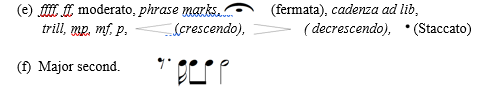
- List any four terms or signs used in the piece.
Observation
Candidates were expected to study the set-piece and respond accordingly to the questions. However, candidates’ performance was on the average in this question. Candidates should have responded to the question in the following ways:
- Romantic
- Allegro maestoso
- G major and B flat major
- Treble staff is monophonic (one line melody) while Bass staff is homophonic (chordal)

(d) Franz Schubert, Felix Mendelssohn, Richard Wagner, Franz Liszt, Robert Schumann, Frederic Chopin, Hector Berlioz, Guiseppe Verdie, Clara Schumann, Antonin D’vorak, Johannes Brahms, Charles Gounod.

Or
With reference to Atentenata in C (OPUS 3 NO.1) by C.W.K.Mereku.
- State the nationality of the composer.
- Which rhythm is predominant in the melody?
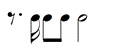
- Quote the opening bars of the melody from the point of entry.
- Identify any two keys the piece modulates to.
- List any four terms or signs used in the music.
- At what interval does the atenteben transpose to be in concert with the piano?
Candidates were expected to study the set-piece and respond accordingly to the questions. However, most of the candidates performed poorly in this question, they went outside the piece to mention general compositional devices. This resulted in loss of marks. Candidates should have responded to the question in the following ways:
With reference to Atentenata in C (OPUS 3 No. 1) by C.W.K Mereku
(a) Ghanaian
(b)
(c)
(d) E flat major, G minor, F major.